
Supporting Your Child’s Healthy Visual Development
Comprehensive eye exams are essential for monitoring your child’s visual development and maintaining long-term eye health. Vision is closely tied to how children learn and interact with the world, making regular checkups vital for identifying issues that could interfere with their growth.
We provide a friendly, welcoming environment where children feel at ease. Our optometrists are parents themselves, so we understand the importance of a patient, gentle approach when caring for young eyes.
Is your child ready for their next eye exam? Book their appointment today.
How Often Does My Child Need an Eye Exam?
As children grow, their eyes undergo significant changes, which is why we recommend annual eye exams.
Our clinic begins seeing children at 5 years old to help prepare them for the visual demands of the classroom. While yearly visits are standard, we may suggest more frequent appointments if necessary, particularly for children undergoing myopia management who require closer monitoring.
Common Vision Problems in Children
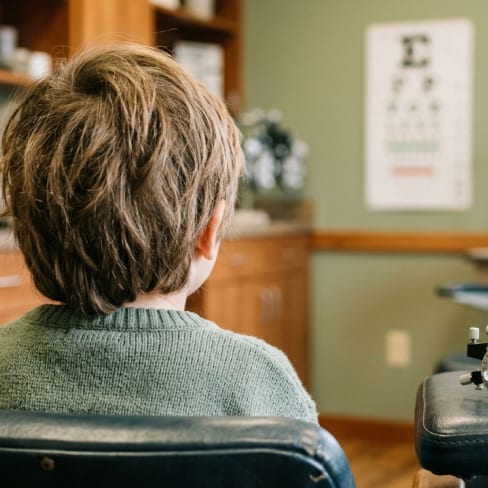
Children often experience refractive errors like nearsightedness or farsightedness, as well as developmental concerns such as amblyopia or strabismus. If these problems are not corrected during childhood, they can lead to developmental delays or permanent vision problems as the eyes attempt to compensate for their condition.
Vision problems are not always obvious. Because children lack a baseline for clear sight, they may not complain or realize their vision is blurry. You can help your child by watching out for the following symptoms that may indicate a vision problem:
- Squinting
- Tilting their head to see or read
- Covering or closing one eye
- Avoiding near work, like reading
- Short attention span, particularly for near work
- Frequent headaches
- Holding objects close to their face, like books, tablets, or Legos
- Poor hand-eye coordination
If you notice any of these symptoms, we recommend bringing your child in for an eye exam.
Myopia (nearsightedness) and hyperopia (farsightedness) occur when the shape of the eye prevents light from focusing correctly on the retina.
These conditions can make schoolwork or sports difficult by causing blurred vision at various distances. We provide precise prescriptions to help your child see clearly and comfortably.
Myopia, in particular, can progress quickly during childhood, as the eye begins to grow too quickly or too long, making distant vision blurry. Myopia control can help slow this progression.
Commonly known as “lazy eye,” amblyopia occurs when the brain favors one eye over the other, leading to reduced vision in the weaker eye.
If identified early, eye patching, glasses, and vision therapy can be used to encourage the brain to process images from both eyes correctly. Early intervention is key to supporting balanced visual development.
We assess amblyopia during our children’s eye exams, and if necessary, we can refer your child to a local vision therapist for treatment.
Strabismus is a condition where the eyes do not align properly and point in different directions. This misalignment can interfere with depth perception and may lead to amblyopia if left untreated.
Our exams check for eye teaming and alignment to help both eyes work together effectively. When needed, we can refer out to a vision therapist for treatment.
Neither amblyopia nor strabismus will improve without interventions. With timely treatment, strabismus can be corrected with excellent results.
Keratoconus involves a thinning of the cornea that causes it to bulge into a cone-like shape, resulting in distorted vision.
While less common in young children, keratoconus often begins in the teenage years and requires specialized monitoring. Regular exams allow us to track corneal health and provide appropriate management as the eye matures.
Myopia Control for Nearsighted Kids
Progressive myopia occurs when a child’s nearsightedness worsens rapidly as they grow. It is important to monitor these changes carefully, as high levels of myopia are linked to an increased risk of serious eye conditions later in life. Myopia control aims to slow this progression, helping to stabilize a child’s prescription at a lower level and preserving their long-term eyesight.
Our practice offers Stellest lenses, which are specially designed eyeglass lenses that slow myopia progression by 71% on average compared to standard single-vision lenses. These lenses provide clear vision while simultaneously managing the growth of the eye.
For your child’s comfort and confidence, Stellest lenses can be shaped to fit almost any frame they choose.
[Embed video]
Schedule Your Child’s Eye Exam in Prescott Valley
Regular eye care is a fundamental part of your child’s health and academic success. By identifying vision concerns early and using myopia management, we can help protect their sight as they grow.
We also recommend that parents limit their child’s screen time, as prolonged exposure to digital devices has been associated with an increased risk of developing myopia and can lead to uncomfortable eye strain. Instead, children should be encouraged to spend more time outdoors, as this lowers their risk of developing myopia and can benefit their physical and mental health, too.
Our team is dedicated to providing Prescott Valley families with the specialized care children need for a lifetime of healthy vision. Book online or call us today to book a comprehensive eye exam for your child.
Visit Our Location
We’re located in the Bradshaw Medical Plaza just off North Windsong Drive. Free parking is available right outside the clinic.
- Phone: 928-771-9939
- Fax: 928-772-3972
- Email: pvecfd@pveyedoc.com
*We do not have an optician or optometrist available on Fridays. Patients can only pick up glasses and contact lenses.
Our Google Reviews
Our Featured Eyewear Brands








About Us
Specialty Eye Care
Eyewear & Contacts
Contact
- 928-771-9939
- 928-772-3972
- pvecfd@pveyedoc.com