
Enhancing Our Care Through Technology
We are committed to providing our patients with thorough, quality healthcare. To uphold this mission, we use eye care technology that significantly enhances our capability to detect and manage various eye conditions, as well as provide a precise fit for eyewear.
Leveraging these technologies allows us to detect and diagnose conditions in their early stages, preventing long-term damage. Simply put, our eye care technology enhances our preventive healthcare approach.
Learn more about our technologies and book your comprehensive eye exam with us today.
How Technology Makes a Difference
Eye care technology continues to improve our ability to detect small changes in your eye health and vision. From high-resolution images that allow us to see microscopic details to comparing data and images between visits, we can gather a more accurate picture of your eye health and notice small changes early on.
The earlier we can detect eye diseases, the more effectively we can manage them. Many eye diseases do not affect your vision or cause noticeable symptoms until permanent vision loss has occurred. By screening your eyes through annual comprehensive eye exams, we are better able to detect changes and preserve your vision.
Our Diagnostic Technologies
Our diagnostic technologies are used to screen for various eye conditions, such as diabetic eye disease, glaucoma, retinal detachments, and more.
By monitoring your eye health proactively, we can detect small changes to your eyes and vision before larger problems emerge. We’ll share all the images with you during your eye exam and show you our findings.
The Optos retinal imaging device captures a high-definition image of the inside of your eye. This allows us to examine your retina, the light-sensitive layer that lines the inside of your eye, as well as the blood vessels, optic nerve, and macula.
Optos imaging helps us detect signs of retinal holes and tears before they proceed to large-scale retina detachments. They also allow us to monitor the health of the blood vessels inside the eye, an important component of diabetic eye exams.
We use the iCare tonometer to check your internal eye pressure, or intraocular pressure (IOP). The iCare tonometer is used instead of the “puff test”.
Eye pressure checks are an important diagnostic tool to screen for glaucoma, an eye disease that can include elevated eye pressure and lead to vision loss if left untreated.
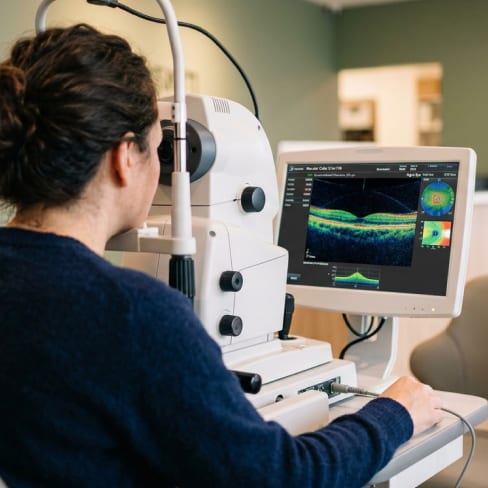
Optical coherence tomography, or OCT, is a powerful diagnostic tool that allows us to see not only inside your eye but also map the different layers of your eye and retina.
OCT scans work like an ultrasound, but use light waves instead of ultrasound waves to map the layers of your eye. An OCT scan can show us the thickness of your retinal layers, allowing us to detect early signs of diabetic eye disease or wet macular degeneration.
We use a Visual Field Analyzer to provide and track an objective measurement of your visual field. This includes the entire area your eyes can see in any direction while fixed on a central point, or in other words, both your central and peripheral vision.
Tracking your visual field can give us important insight into changes to your vision over time that may indicate eye conditions such as glaucoma, which may gradually affect your peripheral vision before other symptoms occur.
For Your Perfect Prescription
We use technology for more than eye health screenings. We also use innovative eye care devices that help make finding your prescription and fitting contact lenses easier and more accurate.
During your eye exam, you’ll notice the phoropters, the giant, silly glasses device that your optometrist will use to ask you whether 1 or 2 looks better. If you’re getting contact lenses, you’ll also have the surface of your eye mapped using a corneal topographer so we can provide a precise fit.
Learn more about each device by clicking on the titles.
Phoropters are used to determine your prescription. The Macro TRS-6100 automated phoropter makes this process faster and simpler for you.
We can also easily show you the difference between your old and current prescriptions, so you can instantly see the difference.
Corneal topography maps the front surface of your eye. This is essential for precisely fitting contact lenses, especially for specialty lenses such as sclerals. The device provides a clear image of your eyes so we can design custom contact lenses made for you.
We use the Optikam device to capture precise digital measurements of how your frames sit on your face. This data allows us to design your lenses with pinpoint accuracy, accounting for the tilt and wrap of your chosen frames.
This technology helps reduce distortion and provides a more natural viewing experience, especially for complex prescriptions, such as progressive lenses.
Book Your Eye Exam Today
Experience eye care that invests in your healthy vision, now and in the future. Our team is happy to walk you through any devices used during your exam, so feel free to ask us questions.
We’re here to help make your eye care experience simpler, easier, and more complete. Schedule your next appointment today.
Visit Our Location
We’re located in the Bradshaw Medical Plaza just off North Windsong Drive. Free parking is available right outside the clinic.
- Phone: 928-771-9939
- Fax: 928-772-3972
- Email: pvecfd@pveyedoc.com
*We do not have an optician or optometrist available on Fridays. Patients can only pick up glasses and contact lenses.
Our Google Reviews

Our Featured Eyewear Brands













About Us
Specialty Eye Care
Eyewear & Contacts
Contact
- 928-771-9939
- 928-772-3972
- pvecfd@pveyedoc.com